
The Last of the Romanovs
- Nostalgic Reader

- Sep 24, 2023
- 11 min read
11 Books About the Doomed Russian Imperial Family

Russian Imperial family aboard the Standart, c. 1906
Ever since viewing the 1997 animated film Anastasia as a child, I have been intrigued by the Romanovs, the last rulers of Imperial Russia. Though still among my favorite childhood movies, it is wildly historically inaccurate in nearly every aspect. My mother watched it with me when I was eight or nine and informed me that the real Grand Duchess Anastasia was murdered and did not live happily ever. Rather than being horrified or disturbed, I grew more interested in learning about the true history of Anastasia and her family. I began by reading the children’s books Angel on the Square and Anastasia: The Last Grand Duchess, 1914 from the Royal Diaries series and worked my way up to biographies of her father, Nicholas II, the last tsar. Since then, I have read many dreadful to mediocre fictional accounts of the royal family, as well as several fantastic historical non-fiction books.
The tragedy of the final generation of Romanov royalty – particularly that of Anastasia, her siblings Olga, Tatiana, Maria, and Alexei, and her parents Alexandra Feodorovna (Princess Alix of Hesse) and Tsar Nicholas II – has kept the details of their lives in the public interest for over a century. From the unique love story of parents Nicky and Alix, their contentious involvement with the debauched, mystical, “holy man” Grigori Rasputin, the secret of their son Alexei’s hemophilia, the matching outfits worn by their beautiful daughters, and the thousands of photographs of their private domestic life, to their horrific execution by firing squad in a cellar in Siberia, the legacy of this family endures in countless forms of media from books, to film, to stage musical. Under a different form of government, such as the constitutional monarchy of Great Britain, the Romanovs would have been beloved. For decades after their murder, rumors abounded that one of the children escaped the slaughter – a romantic fantasy kept alive until 2007, when the final missing two bodies of the royal family were discovered (the others being previously exhumed in 1991 and DNA tested to confirm their identities). In their death, the martyred family has become beloved – or, at the very least, a source of fascination – by the generations of people still seeking out their story.
Eighteen members of the Romanov family were hunted down and killed by the Bolsheviks in the upheaval of the Russian Revolution and subsequent civil war. The books listed below recount the lives of many that were lost, as well as those who escaped, in the wake of the destruction of the Imperial Russian Empire.
Note: Russian naming conventions use patronymics – a secondary or “middle” name derived from the father’s first name. I use various patronymics in this review to distinguish between members of the Imperial family, as many of the Romanovs share the same first name.

1 | Nicholas and Alexandra Robert K. Massie
This substantial dual biography is the definitive account of the lives of the last Russian tsar and his wife, a German princess, from their courtship to coronation, from tenuous reign to exile and execution. The Imperial couple’s union is unusual in that it is a love match, not arranged like most royal marriages. Through their struggles and failure to rule a vast empire in turmoil and produce a healthy heir, they find solace in one another and their children and inextricably tie their destinies to the ill-reputed Rasputin for the sake of relieving their ailing son’s chronic pain, all to the detriment of the nation.
First published in 1967, this volume lacks certain information about the fate of the Romanovs, then unknown, which later came to light and can be found in Massie’s sequel The Romanovs: The Final Chapter. This biography became the source material for the 1971 Academy Award-winning film Nicholas and Alexandra. The book provides an in-depth character study of the two royal figures and details the political climate surrounding their reign. I would highly recommend this book to anyone interested in a comprehensive biography of the last Romanovs.
My Goodreads Rating: 4 Stars

2 | Nicholas II, The Last Tsar Michael Paterson
In 1896, Nikolai Alexandrovich Romanov ascends the Russian throne at the age of 26 as Nicholas II. His father, the iron-fisted ruler Alexander III, has died unexpectedly at the age of 49, leaving Nicholas unprepared to fill his shoes. The newly-named tsar insists on marrying for love despite his mother’s warning that Alix of Hesse is unfit to take on the role of Empress consort – a prediction that proves to be true. As the country spirals toward war and revolution and pressures mount on Nicholas, he retreats more and more into his family life, making ill-advised decisions or neglecting his responsibilities altogether. Ultimately, he is forced to abdicate amid the upheaval of the 1917 revolution.
A condensed overview of the life and reign of Nicholas II, this biography is largely sympathetic to the last tsar. Paterson presents both Nicholas’s strengths and weaknesses, acknowledging that while he was clearly unsuited to be an autocratic ruler, he was a good husband and father. Nicholas unwisely put his family before his country, which he loved in a patriotic sense but did not understand with any political acumen. The author brings to light some of the tsar’s early positive reforms that would later be forgotten, overshadowed by poor decisions with disastrous outcomes. While history largely depicts the last tsar as deserving of his fate, Paterson paints the portrait of a mere human being placed in an impossible position as one who felt obligated to continue the traditions of his father yet yearned for a life of domestic simplicity.
My Goodreads Ration: 5 Stars

3 | The Last Days of the Romanovs: Tragedy at Ekaterinburg Helen Rappaport
Nicholas II abdicates the throne of Russia in March of 1917. A provisional government is established and overthrown later the same year by the communist Bolsheviks, who install the Soviet regime. First imprisoned in the Alexander Palace in Tsarskoye Selo, the royal family is then sent to Tobolsk in Siberia for their protection under the Provisional Government. After the Bolsheviks take power, the fate of the dethroned Imperial family is sealed. While some fear the backlash of turning them into martyrs, the consensus among the Bolsheviks is to eliminate the Romanovs. Civil war breaks out between the communist Reds and counterrevolutionary Whites, prompting the Bolsheviks to move the Romanovs to the Siberian city of Ekaterinburg, far from the reach of any sympathetic forces attempting to rescue them. Nicholas, Alexandra, their five children, and four loyal servants spend their final days in the Ipatiev House, given the ominous name “The House of Special Purpose.”
Despite being familiar with the events surrounding the murder of the Romanovs, I found this non-fictional account riveting. Rappaport depicts the narrative in an engaging manner like a thriller novel. A sense of doom closes in on the family as White liberating forces draw nearer and their captors grow more anxious to dispose of them while waiting on consent from Bolshevik leader Vladimir Lenin. I admit that I felt physically sick reading the highly detailed account of the night of the execution, but the unfathomable horror of this tragedy – particularly the inclusion of the innocent children and servants in the slaughter – is why the legacy of the Romanovs endures in captivating the public over a century later.
My Goodreads Rating: 5 Stars

4 | Michael and Natasha: The Life and Love of Michael II, the Last of the Romanov Tsars Rosemary & Donald Crawford
Before Tsarevich Alexei Romanov is born in 1904 to Nicholas II, Grand Duke Michael Alexandrovich, the tsar’s younger brother, is the heir apparent. Considering the new heir Alexei’s hemophilia – a blood-clotting disorder often resulting in death at a young age – Michael is forced to live with the weight of possibly inheriting the throne, prohibiting him from marrying the woman he loves. Natasha Sheremetevskaya is a twice-divorced woman of untitled nobility, an improper match for a grand duke who could one day be the ruler of Russia. Dynastic laws would invalidate his ability and that of any sons born to Natasha to inherit the throne. Fearing becoming the heir again when his nephew falls ill, Michael decides to elope with Natasha and remove himself from the line of succession. However, when his brother Nicholas abdicates the throne for himself and his sickly son, the long-dreaded fate of becoming the tsar catches up with Michael.
This biography is a heartfelt and tragic look into the life of a more obscure historical figure who was once heir to the Russian throne and tsar for less than 24 hours. After years of reading about the primary cast of characters surrounding the Russian Revolution and the final days of the Romanov dynasty, I was intrigued to learn more about Michael, a well-liked man, and beloved son, brother, and husband. Many of his troubles in life, from marriage woes to political responsibilities to his untimely death, were due simply to the circumstances of his birth into the royal family. He served as a major-general during the First World War in an apparent demotion because of his unapproved elopement with Natasha. Despite his assignment to command the newly formed Caucasian Native Division comprised of inexperienced Muslim recruits, Michael was well-respected among his men and earned the military’s high honor, the Order of Saint George. Under different circumstances, Michael may have been a competent ruler who paved the way for constitutional monarchy or led a quiet life as a doting husband and father. However, his unfortunate place in history robbed him of those opportunities.
My Goodreads Rating: 4 Stars

5 | Queen Victoria and the Romanovs: Sixty Years of Mutual Distrust Coryne Hall
Princess Juliane of Saxe-Coburg, aunt of Queen Victoria, is the first of the British monarch’s family to marry into the Romanov dynasty of Russia in 1796. The marriage ends in disaster, annulled in 1820. Political tensions and personal relationships entangle England and Russia for over a century in suspicion, war, love, and marriage. Victoria’s son Prince Alfred marries Grand Duchess Maria Alexandrovna of Russia, daughter of her former flame but impossible suitor Tsar Alexander II, a marriage which also results in unhappiness. Two of Victoria’s granddaughters, Ella and Alix of Hesse, later marry into the Imperial Romanov family, much to the queen’s displeasure.
Drawing on excerpts from Queen Victoria’s journals, Romanov expert Coryne Hall illustrates how the complex family tree of these two royal households were often at odds and other times in alliance. Queen Victoria was rather astute in her assessment and fears of the fate of Russian monarchy and was justified in her hesitance to allow her descendants to marry into the Romanov family. Towards the end of her life, however, she softened toward the Russian family and granted permission for her favorite granddaughter, Alix, to marry the future Tsar Nicholas II, who had won Victoria over with his mild, amiable temperament and nearly perfect English.
My Goodreads Rating: 4 Stars

6 | George, Nicholas, and Wilhelm: Three Royal Cousins and the Road to World War I Miranda Carter
When the First World War breaks out in 1914, seven of Queen Victoria of England’s nine children and 42 grandchildren sit on thrones in Europe and take sides in the global conflict. King George V of England, Victoria’s grandson, Tsar Nicholas II of Russia, husband of Victoria’s granddaughter Alix of Hesse, and Kaiser Wilhelm II, another grandson, are all cousins multiple times over thanks to centuries of intermarriage between European royalty. The three cousins’ interpersonal relationships directly influence the alliances that form and the provocations that lead up to the war. After centuries of distrust between England and Russia, beginning in the late 1880s, the two countries’ queens, Danish sisters Alix (Queen Alexandra of England) and Minnie (Maria Feodorovna of Russia) attempt to forge Anglo-Russian ties. They eventually succeed decades later when their sons George and Nicholas join France in an alliance which surrounds Germany, unsettling their least favorite cousin Wilhem, and destabilizes the peace in Europe.
This triple biography is a fascinating exploration into the lives, relationships, and fates of three cousins occupying royal thrones during the last days of European monarchy. By the end of the war, one would be executed, one would be exiled, and one would endure as a royal figurehead devoid of any real power. I found it particularly heartbreaking to learn how George, previously a good friend of Nicholas, wrote to British Prime Minister David Lloyd George and asked him to rescind England’s offer of asylum when the Russian monarchy was overthrown, fearful of similar events occuring in his own country. George’s decision, covered up so the prime minister would take the blame, likely sealed the fate of his cousins Nicholas and Alexandra and their children. Many of the details in this biography are presented in the two-part BBC documentary Royal Cousins at War, in which author Miranda Carter appears as one of the featured historians.
My Goodreads Rating: 5 Stars

7 | After the Romanovs: Russian Exiles in Paris from the Belle Epoque Through Revolution and War Helen Rappaport
In the wake of the 1917 Russian Revolution, many Russian aristocrats and members of the extended Imperial family flee to France. The nobility has had an affinity for French culture and language since the 19th century, and many frequently visit or keep apartments in Paris. However, during the First World War it is considered unpatriotic to keep foreign bank accounts, so many formerly wealthy aristocrats escape with little or no funds and try to rebuild their lives among the working class as business entrepreneurs, cab drivers, and even laundresses.
After the Romanovs follows the lives of many lesser-known Romanovs from the 1870s through the 1930s, including Grand Duke Nicholas Nikolaevich of Russia, cousin of Nicholas II and Commander-in-Chief of the Russian Imperial Army during World War I; Grand Duke Kirill Vladimirovich, cousin of Nicholas II and self-proclaimed Emperor in Exile as head of the surviving Romanov family; Princess Irina Alexandrovna, niece of Tsar Nicholas II, her husband Prince Felix Yusupov, who plotted the murder of Rasputin, and his co-conspirator Grand Duke Dmitri Pavlovich, another cousin of Nicholas II. While I found this account captivating – I am an avid fan of Rappaport’s writing – it was disheartening to read about this group of people whose way of life had been destroyed and, in most cases, who failed to prosper, either dying in poverty or in Soviet gulags, the desire to return to their homeland too strong to resist.
My Goodreads Rating: 4 Stars
The Romanovs in Historical Fiction
In my opinion, most fictional novels about the Romanovs are garbage. Many authors cannot resist the temptation to concoct a miraculous escape for one of the children from the slaughter in Ekaterinburg. When I was younger, I found this romantic yet unrealistic trope palatable or even desirable, but nowadays I generally find it distasteful. A few novels that largely stick to the facts with minimal artistic license have struck me as being worthwhile reads:

8 | The Romanov Empress: A Novel of Tsarina Maria Feodorovna C.W. Gortner
This book recounts the life of the mother of Tsar Nicholas II, wife of Tsar Alexander III, Danish princess, and sister to Queen Alexandra of England. She witnessed and survived more than 50 years of turbulent history in the Russian Imperial Court, saw the reigns of the last three Romanov tsars, fled in 1919 during the Russian Civil War, and eventually returned to her homeland of Denmark, outliving many of her children and grandchildren.
My Goodreads Rating: 5 Stars
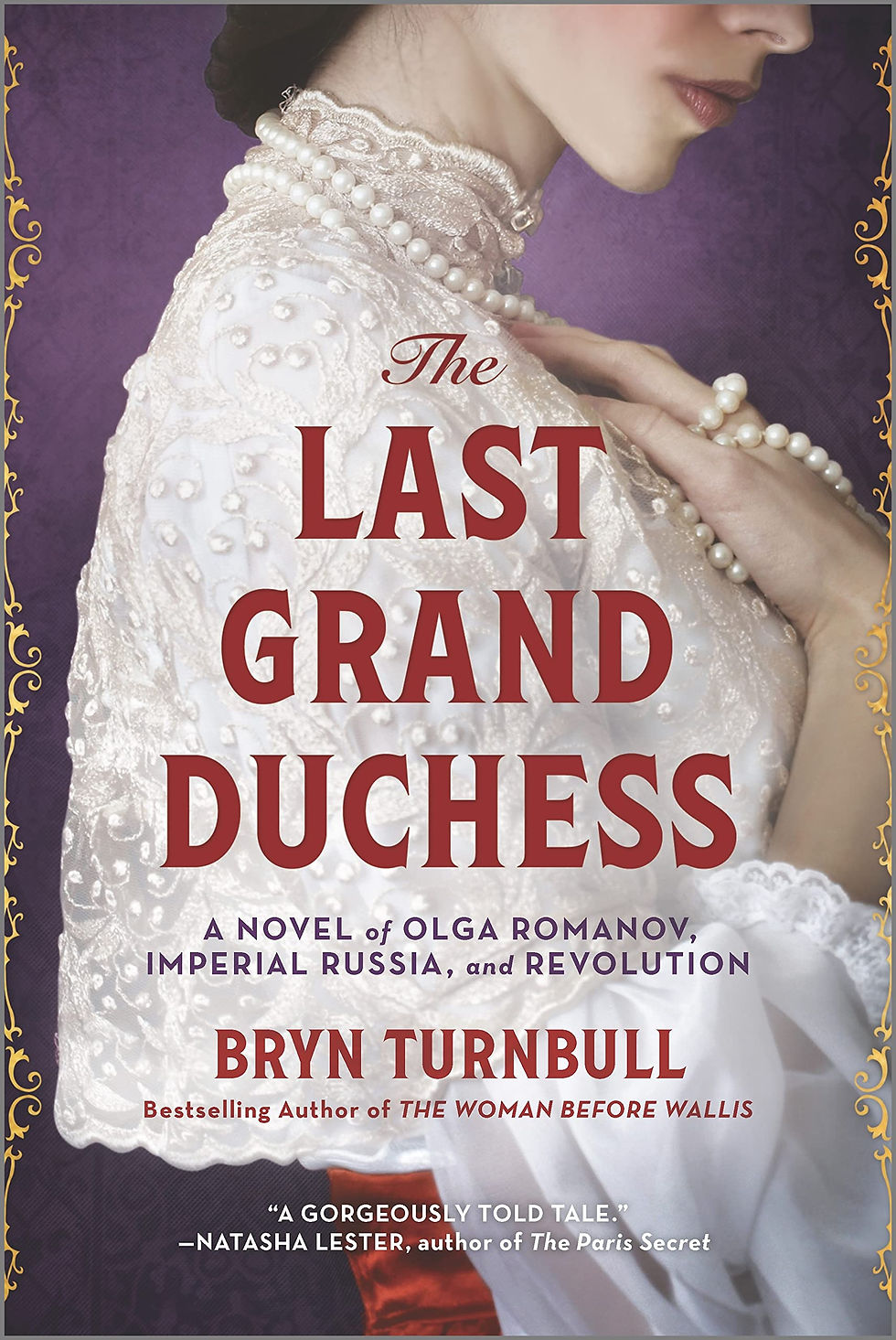
9 | The Last Grand Duchess: A Novel of Olga Romanov, Imperial Russia, and Revolution Bryn Turnbull
Relying heavily on the diaries of the real-life Olga Nikolaevna Romanova, this narrative follows the brief life of the eldest daughter of Tsar Nicholas II. Though fictionalized, the author tries to remain true to the facts and does not find a preposterous way to save her heroine. I found this book interesting because Olga is rarely the subject of historical fiction (authors tend to prefer Anastasia or Tatiana). As the eldest child of the tsar, she possessed a unique status. Had Russia allowed women to rule (a law prohibiting this was enacted following the 18th-century reign of Catherine the Great), she could have been named the heir to the throne. Thus, the secrecy surrounding her brother Alexei’s illness would have been unnecessary, potentially changing the course of history.
My Goodreads Rating: 4 Stars

10 | The Kitchen Boy: A Novel of the Last Tsar Robert Alexander
Told through the eyes of the kitchen boy who attended the royal family during their final days in Ekaterinburg and was sent away just prior to their execution, the reader is provided clues that the narrator is not in fact the kitchen boy but someone else who was in the house at the time and had contact with the Romanovs. Led to assume a certain conclusion, I was completely shocked at the final reveal. While the author altered some details of the fateful night, I was pleasantly surprised the novel remained closer to reality than I had anticipated and had a humdinger of an ending.
My Goodreads Rating: 5 Stars

11 | I Was Anastasia Ariel Lawhon
This novel features a dual timeline of the infamous Grand Duchess Anastasia and the woman who claimed to be her. The real-life mystery of Anna Anderson, which inspired a 1956 movie starring Ingrid Bergman and later the 1997 animated musical, is tackled here in an interesting way, leaving the reader to doubt whether this unknown woman who turned up in Berlin in 1925 is truly the lost grand duchess or an imposter until the two timelines moving in reverse order finally collide. DNA testing has confirmed the real identity of Anna Anderson to be Franziska Schanzkowska, a Polish factory worker, but in historical fiction, anything goes!
My Goodreads Rating: 3 Stars


Another excellent compilation of books -- both nonfiction and fiction -- that you have shared with us. I love the fact that you are both candid and respectful of the authors and their works. It has inspired me ... on many the occasion ... to alter my reading selections' schedule to pick up one of the books you recommend. Thank you.
Books, like anything that is created (paintings/film/architecture, etc.), is so subjective. I, too, read "I Was Anastasia" (I gave it 4-1/2 stars), and while I liked it more than you did, I do appreciate what you have to say about the novel.
Happy Reading! :-)