
Around the World in 365 Days
- Nostalgic Reader

- Dec 31, 2023
- 10 min read
7 Favorite Historical Fiction and Nonfiction Books Read in 2023
As 2023 draws to a close, I have chosen to reflect on some of my most enjoyable reads of the year which traverse the globe from Byzantine-era Constantinople (present day Istanbul) to Nazi-occupied France, from the Siberian and North Korean gulags of the mid-20th century, to post-Cultural Revolution China. As someone who does not travel much in real life, reading allows me to explore the far reaches of the world throughout time. The following list is a selection of some of the best books I read over the course of the year that have stayed with me long after finishing the last page.

1 | All the Light We Cannot See
Anthony Doerr
Destination: FRANCE
The German-occupied walled seaside town of Saint-Malo, France is under siege in August 1944 as American troops draw near, the promise of liberation clinging to the air. The war has brought two teens, a blind French girl named Marie-Laure LeBlanc and an orphaned Nazi radio operator named Werner Pfennig, to Saint-Malo. Their lives hang in the balance as the city is bombed and Werner is tasked with tracking down Marie-Laure’s illegal radio broadcasts from the attic of her grand-uncle’s house. Meanwhile, Sergeant Major Reinhold von Rumpel, a German officer, has learned of a legendary cursed gem called the Sea of Flames which possesses magical healing and destructive powers. He believes it to be in the possession of Marie-Laure, the daughter of a former employee of the Museum of Natural History of Paris, where the gem was housed before the German invasion of France. Von Rumpel believes his life depends on securing the gem and will stop at nothing to find it. The lives of these three converge as the town of Saint-Malo faces the brink of destruction.
I must acknowledge that my viewing of the recent Netflix adaption of All the Light We Cannot See certainly colored my perspective and enjoyment of this novel. I watched the miniseries before reading the book, immersing myself into the story with no preconceptions. I thought the series was beautifully written, filmed, acted, and scored. When I turned to the novel shortly thereafter, I already had strong, positive emotions toward the story, anticipating that the book would only be better. I thought the novel had lovely prose and is worth reading as the source material for the miniseries, but I admit I enjoyed the film adaptation more. Had the series not so heavily informed my intake of the novel, I probably would have rated it lower.
Doerr opens the novel in “present day” August 1944 to set the stage for his main characters and then flashes back several years to show how everyone’s lives have led them to this point, occasionally switching back to the main action in 1944. While the television series applies a similar flow of narrative, jumping back and forth in time, I felt the miniseries was more cohesive and inspiring in what the screenwriter chose to emphasize. The inevitable meeting of the main characters is rather anticlimactic in the novel, whereas it is highly charged and suspenseful in the film adaptation. The characters in the novel were rather flat at times. I found them a bit lacking in depth and growth, especially for a novel over 500 pages in length. My mind filled in details from the miniseries brought to screen by an amended screenplay and talented actors to breathe life into the characters in the book, where such details did not exist. The Netflix series leaves the story rather open-ended on a slightly hopeful note. The novel takes a darker turn and follows the characters many years after the principal action, haunted by their experiences during the war. It left me with a melancholy, though more realistic, outlook on the events and characters portrayed in the novel.
If you are already a fan of the novel, I do recommend watching the Netflix series with the caveat that many details have been changed (for the better, in my opinion). If you are a purest and abhor when film adaptations stray too far from the source material, the series may not be for you. Or, if you’re like me and thought the novel felt rather meandering and lifeless at times, the series may brighten your perspective on the story, which is wonderful in concept if not in execution.
My Goodreads Rating: 4 Stars
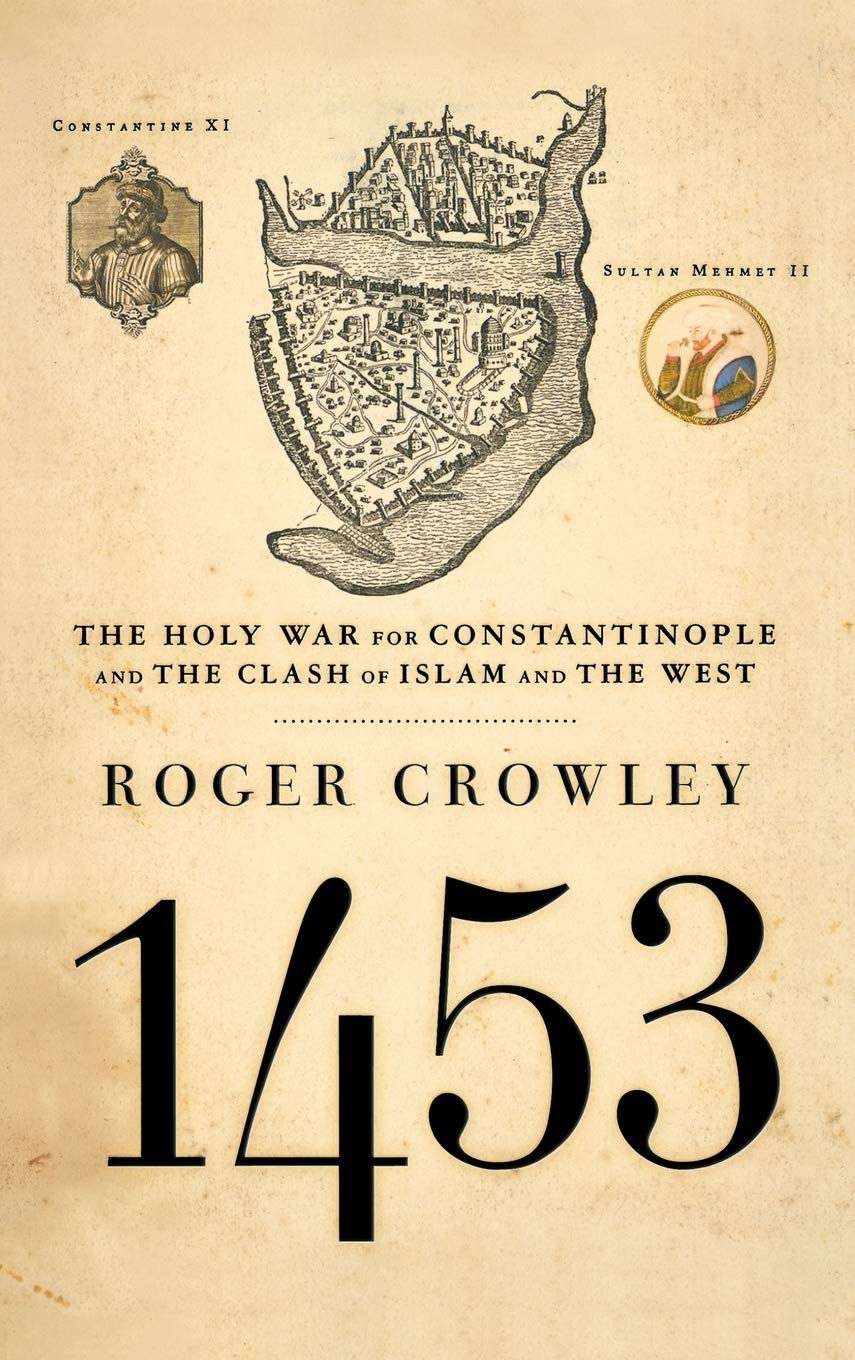
2 | 1453: The Holy War for Constantinople and the Clash of Islam and the West
Roger Crowley
Destination: (PRESENT-DAY) TURKEY
When the Turkish Sultan Mehmed II ascends the throne at age 19, he sets out to accomplish what his father and many previous Ottoman sultans before him have failed to do: conquer the Byzantine capital of Constantinople. Known as the Red Apple, the city of Constantinople is a highly coveted geographical center of commerce at the crossroads of the medieval world where east and west converge. Constantinople is the stronghold of Christianity against the Islamic jihad and the expansion of the Turkish empire. Though young and inexperienced, the ambitious Mehmet II implements new technology and weaponry along with innovative strategies in his 53-day siege of Constantinople while the bankrupt city’s inhabitants seek help from their Italian neighbors to repel the Turks’ attacks with military strength and ingenuity of their own.
1453 is a story of the clash of two emperors, the Muslim Sultan Mehmed II and the Greek Orthodox Emperor Constantine XI. Both men persevered through the siege as no ruler had before. Mehmet II is an intriguing, forward-thinking historical figure who was interested in establishing a multi-cultural metropolis where people of all faiths could live alongside one another peacefully—an unusual concept at the time. What Constantine XI lacked in funds and allies, he made up for in courage and love for his city. While he could have easily fled to save his own life when all seemed lost, he bravely chose to remain with his people and face the outcome of the battle beside them.
I sought out this book after watching the six-part Netflix docudrama Rise of Empires: Ottoman – The Conquest of Constantinople, which chronicles the 1453 siege of the Byzantine capital. Many details from the book are dramatized in the series, and the author himself, Roger Crowley, is featured as one of the historical commentators. I confess that while reading, my eyes periodically glazed over at some of the descriptions of medieval warfare, but having seen the docudrama, I was able to recall and picture various scenes that aided my comprehension of the material. I highly recommend watching the series if you enjoyed the book or as a preface to reading it.
On a side note, I started watching Rise of Empires: Ottoman after seeing a handful of my favorite Turkish actors in the cast list. A few minutes in, I was puzzled to hear British actor Charles Dance narrating a Turkish documentary in English (I had expected the dialogue to be entirely in Turkish). I checked my settings to see if I was watching the dubbed version but found that the series had indeed been filmed in English despite being a Turkish production. I have to applaud all the Turkish actors, who I had only ever heard speaking their native language, for fluently speaking English throughout the drama.
My Goodreads Rating: 4 Stars
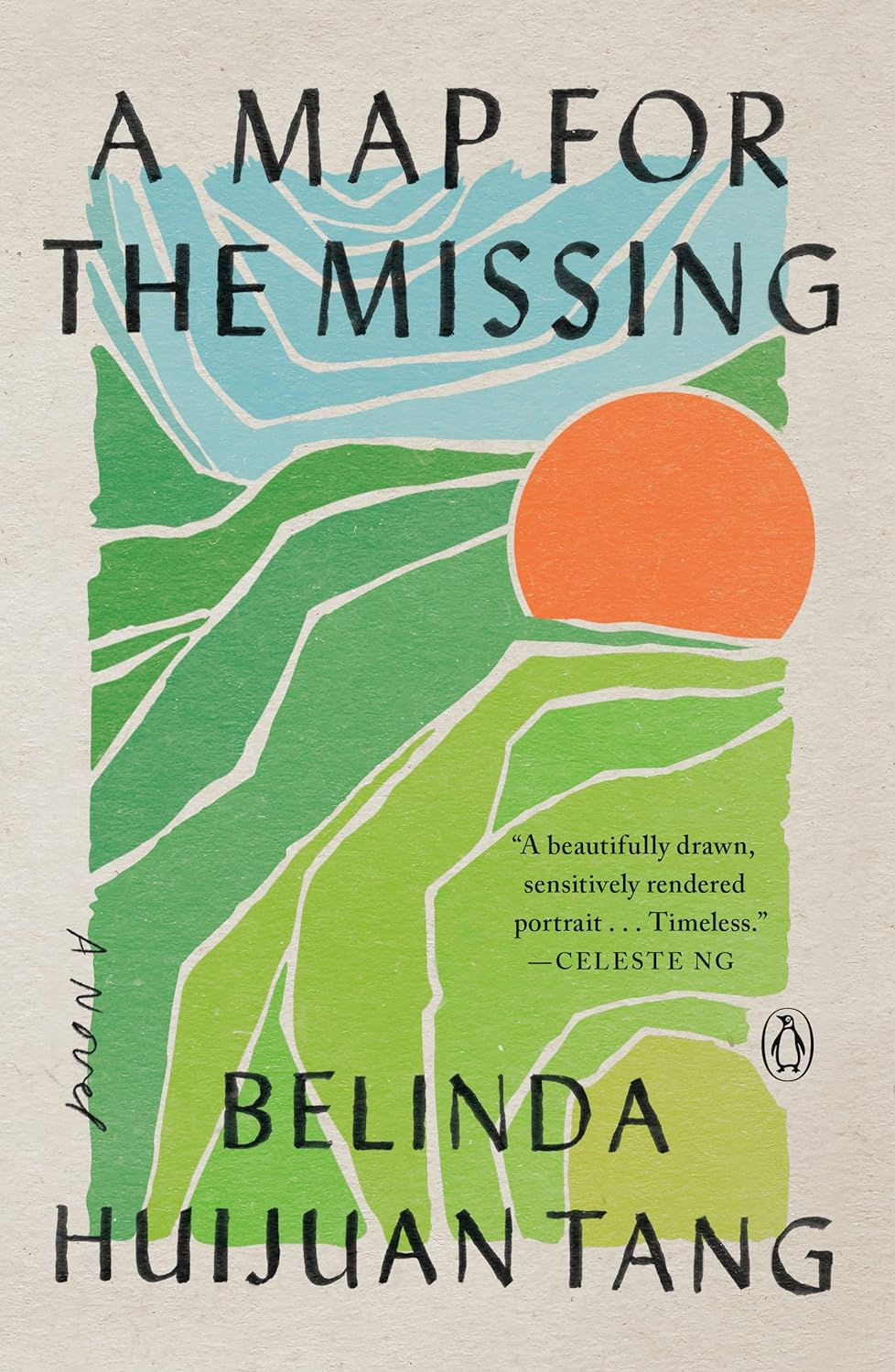
3 | A Map for the Missing
Belinda Huijuan Tang
Destination: CHINA
Tang Yitian has spent ten years building a life for himself in America. He grew up in a rural village in post-Cultural Revolution China, dreaming of pursing higher education and attending college with his girlfriend Tian Hanwen, who has been “sent down” from Shanghai as a part of the country’s rustication. When he receives news from his mother back in China that his father has disappeared, Yitian agrees to come home and help search for him. He reconnects with Hanwen, who has since become a wealthy bureaucrat’s wife. As Yitian follows various leads to track down his father, he reflects on his youth and the family tragedy that estranged him from his father 15 years prior.
Though I am usually not a fan of a dual timeline, I enjoyed how the author utilized this writing device to slowly reveal painful events of the past that have informed the characters’ present situations and frames of mind. In this case, the dual timeline successfully held my attention because it alternated between the past and present of the same group of people rather than completely separate characters. My only qualm was that not only did the timeline jump around but the narrators also switched back and forth between Yitian and Hanwen. At times I appreciated being given an insight into Hanwen’s side of the story, but I felt it was largely unnecessary to use her as a secondary narrator. The story belonged to Yitian and could have been more focused if he had been the sole narrator. That quibble aside, I was invested in the characters’ relationships and aspirations set against the historical framework of a country slowly emerging from an era of horrific oppression and famine.
My Goodreads Rating: 4 Stars

4 | When History Was Made: The Women of 1916
Ruth Taillon
Destination: IRELAND
The Proclamation of the Irish Republic, presented on Easter Monday, 1916 in Dublin guarantees the equal rights and opportunities of all Irish citizens, including the right to vote, regardless of sex. At a time when women globally were not allowed to vote, the promise of equality under the Proclamation was a tantalizing prospect. The women of Ireland took seriously their duty to take up the cause of their fellow men and fight for independence from the British Empire and the right to uphold the Proclamation.
The Easter Rising of 1916 is best remembered for its 16 martyred leaders, executed in the wake of the armed insurrection against the British. The Women of 1916 brings to the forefront stories of the women who helped orchestrate the rebellion, provided aid as nurses and cooks, and even fought alongside the men. This nonfictional book names nearly 200 women who were involved and provides insightful anecdotes, often in the women’s own words, into the scope of female participation in the historic week and the years leading up to it. Often relegated to the footnotes of history, author Ruth Taillon lauds the accomplishments of this gutsy assemblage of women who were engaged in practically every aspect of the Rising, from traditionally domestic tasks such as providing first aid, making uniforms, and running field kitchens to combatant roles serving as arms smugglers, couriers, and sharpshooters. As an Irish history enthusiast who has already read quite a bit about the 1916 Easter Rising, I found this fresh perspective quite fascinating.
My Goodreads Rating: 5 Stars

5 | The Long March Home: A World War II Novel of the Pacific
Marcus Brotherton and Tosca Lee
Destination: PHILIPPINES
Three friends from Mobile, Alabama enlist in the army to escape family and societal pressures and serve their country on the eve of the United States becoming embroiled in the Second World War. The three young men find themselves stationed in the Philippines, carefree and enjoying their time in the South Pacific when Japan attacks Pearl Harbor. An invasion of the Philippines by the Japanese Imperial Army follows shortly thereafter. After months of defending the island with dwindling supplies and no hope of reinforcements, the Americans are forced to surrender to the Japanese. The three friends join the ranks of soldiers who undergo the infamous Bataan Death March and end up in a squalid POW camp. Their friendship and courage are tested as they suffer appalling conditions during their struggle to survive and return to their loved ones back home.
A recent publication, this is the first fictional novel I am aware of covering the Bataan Death March. It is evident the authors drew information from Hampton Sides’ excellent nonfiction book Ghost Soldiers. Author Marcus Brotherton has also collaborated on nonfictional projects with real-life subjects from the HBO miniseries Band of Brothers and The Pacific. His knowledge and research of the subject matter shines through in this fictional novel.
From an emotional perspective, this is a powerful narrative of endurance and sacrifice. Early on, I formed an idea in my head about how I believed the characters’ arcs would play out, but their journeys were pleasantly unpredictable. The novel wraps up in an unexpected, heartbreaking, yet satisfying conclusion. Few books bring me to tears, but I found my eyes welling up towards the end of the story. When I turned the final page, I had to take a few moments to process everything and allow this impactful novel sit with me. I highly recommend this book to anyone who is interested in the Pacific theater of World War II, especially if you prefer fiction to nonfiction.
My Goodreads Rating: 5 Stars

6 | Between Shades of Gray
Ruta Sepetys
Destination: SIBERIA
In 1941, Soviet officers arrest 15-year-old Lina and her family and send them away from their home in Lithuania to a work camp in Siberia. They are shuffled onto a crowded train, where they witness sorrow and death on their lengthy journey. During the years that follow, Lina and her family struggle to endure the harsh conditions of the freezing Arctic Circle gulag. Despite the risk of being discovered, Lina uses her artistic ability to record her experiences in drawings, keeping her spirit and hope for survival alive.
This fictional novel is categorized as Young Adult, but the depth of the subject matter is still enjoyable to read as an adult. Lina’s tale is eye-opening for anyone unfamiliar with the Soviet gulag system, yet inspiring as story of resilience. The novel has been adapted for film under the title Ashes in the Snow (in order to distinguish it from the wildly different book and film 50 Shades of Gray). If you enjoy the book Between Shades of Gray, the movie is definitely worth watching. I feel the film is a sufficiently faithful adaptation with a few minor changes. The heavy content is portrayed well while maintaining the youthful perspective of the novel, which is rooted in hope.
My Goodreads Rating: 5 Stars

7 | The Aquariums of Pyongyang: Ten Years in a North Korean Gulag
Kang Chol-Hwan & Pierre Rigoulot
Translated by Yair Reiner
Destination: NORTH KOREA
Kang Chol-Hwan is born to a Korean family who had prospered in Japan during the Second World War and was lured to North Korea by the promise of a socialist utopia in the 1960s. Chol-Hwan spends his early childhood years in comfort among the elite in the capital city of Pyongyang. At the age of nine, after years of devotion to the communist government, Chol-Hwan’s family is arrested for reasons unknown and sent to Yodok, a notorious labor camp. It becomes evident that his grandfather has fallen out of favor for some behavior which has branded the family as enemies of the state. Though the conditions are abysmal, the Yodok camp offers the rare opportunity for “redemption” and eventual release. After ten years of imprisonment, Chol-Hwan and his family are allowed leave the gulag and return to society. Disillusioned by the decade of internment and hypocrisy he has witnessed, Chol-Hwan seizes the opportunity to escape North Korea, knowing he may never see or hear from his family again.
The Aquariums of Pyongyang, first published in 2001, is among the first attempts to reveal the true nature of the brutality of the North Korean regime and the violation of human rights perpetuated by the nation’s gulags. Kang Chol-Hwan was one of the earliest defectors and advocates for international intervention and liberation of North Korea. I was surprised to learn how terrible conditions were in the prison camps even before the famine crisis of the 1990s, which prompted a steady stream of defectors to flee across the Chinese border. This memoir is a compelling testament to one young man’s remarkable ability to adapt to his ever-changing circumstances and impassioned efforts to raise awareness and bring about positive transformation to his native country.
My Goodreads Rating: 5 Stars
Other 5-Star Favorites of 2023 from Previous Posts:
The Great Leader and the Fighter Pilot – Blaine Harden
A River in Darkness – Masaji Ishikawa
When We Had Wings – Ariel Lawhon, Kristina McMorris, Susan Meissner
Rescue at Los Baños – Bruce Henderson
Ghost Soldiers – Hampton Sides


Comments