
Agatha Christie and the Unsolvable Mystery
- Nostalgic Reader

- May 28, 2023
- 6 min read
5 of the Queen of Crime’s Lesser-Known Novels

British mystery writer Agatha Christie’s structuring of the classic detective novel earned her the moniker “Queen of Crime.” Her thorough knowledge of poisons (gained while serving as a nurse during World War I) gave credence to the logistics of her murders. Her plot twists and experimentation with writing devices have made her books wildly popular and practically unsolvable given the scant clues afforded the reader. Well-traveled, her experiences abroad gave her novels set in exotic locations a sense of adventure absent from the standard English country house murder mysteries. Christie published her first novel, The Mysterious Affair at Styles, introducing the famous Belgian detective Hercule Poirot in 1920. Over the next five and a half decades, Christie published 66 novels and 14 collections of short stories, most of which have been adapted for film and/or television, and more than 20 stage plays. Five of her most famous books (And Then There Were None, Murder on the Orient Express, Death on the Nile, The ABC Murders, and Evil Under the Sun) have been adapted as PC mystery games. Do I own all of them? Why yes, I do.
I have read most of Christie’s body of work and though I don’t recall the plots of all 69 books I’ve read over the past 20 years, several stand out in my memory as being exceptional. Oddly enough, they are mostly among Christie’s lesser-known standalone novels. Three of the novels on my list (Endless Night, Towards Zero and Crooked House) made the cut into Christie’s own top ten favorites as stated in response to fan letter in 1972. Unquestionably, her most popular standalone novel is And Then There Were None, selling roughly 10 million copies worldwide. It’s one of my favorites as well, though not applicable to this list. The following five novels are somewhat obscure in the Christie canon and do not belong to the famous Hercule Poirot, Miss Marple, or Tommy & Tuppence series.

1 | Endless Night
First published 1967
Newlyweds Mike and Ellie buy an abandoned property in the woods once known as Gipsy’s Acre and decide to build their dream house. They are warned to leave by an old gypsy woman because the land is supposedly cursed, and misfortune is sure to befall them if they stay. When a mysterious death occurs, it appears either the curse is coming to fruition, or someone has a reason to plot murder.
The big reveal at the end of this novel is genius. However, the setup of events is rather slow-paced. At times, it’s easy to forget that it’s a mystery due to the absence of suspicious events and characters for nearly three quarters of the story. The seemingly mundane details are all intentional and provide clues about who, why, and how someone will die. As a psychological study of an unsuspected crime, Agatha Christie’s writing is phenomenal. I’ve alternated between giving this book three and four stars. Ultimately, I bumped my rating down to three stars due to the lack of suspense until the last 50 pages despite my appreciation for the ending.
My Goodreads Rating: 3 Stars

2 | They Came to Baghdad
First published 1951
Recently unemployed short-hand typist and pathological liar Victoria Jones meets a handsome, amiable former RAF fighter pilot in London. On a whim, she decides to follow him to Baghdad, proclaiming herself to be the niece of a renowned archaeologist, Dr. Pauncefoot Jones, currently on a dig in the Middle East. Once she sets foot in Baghdad, she finds herself embroiled in a Cold War conspiracy involving espionage, murder, and even her own kidnapping.
This adventure/espionage thriller is a departure from Agatha Christie’s usual whodunnit detective novels. The main character is a witty, audacious young woman who flies by the seat of her pants when confronted with danger and complications to her travel plans. I enjoyed the cleverness of this mystery and the spunkiness of protagonist Victoria Jones who isn’t quite intellectual enough to decipher all that is transpiring around her but clever enough to get herself out of a jam. Of course, never count out the Queen of Crime to thrown in unexpected plot twists to keep the reader on their toes.
My Goodreads Rating: 4 Stars

3 | Death Comes as the End
First published 1944
Set in 2000 B.C. Egypt, recently widowed Renisenb returns to her family villa on the Nile river to find that while much remains unchanged, tensions arise when her father Imhotep brings home a new, outspoken concubine, Nofret, who rubs everyone the wrong way. Nofret convinces Imhotep to disinherit his own children over their cold reception toward her. When the detested concubine is found dead at the bottom of a cliff, the tragedy is deemed an accident for the sake of convenience. However, the entire household is certain it was no accident, but murder. As more deaths in the family ensue, it becomes clear there is a greater, more sinister scheme at play, and anyone could be killed next.
This novel is Agatha Christie’s only historical mystery, as the remainder of her works are set roughly during the time in which they were written. As an ancient Egyptian enthusiast, I found the setting made the novel more intriguing. As Christie mentions in her Author’s Note, the story could have been set in any time or place, but the inspiration for the characters and plot came from Egyptian letters of the XI Dynasty found during a Metropolitan Museum of Art expedition during the 1920-21 season. The story structure and plot-twists are solid as usual. I was sure I had figured out who the murderer was yet found myself proven wrong. The distinctiveness of the mystery and its setting earned five stars from me.
My Goodreads Rating: 5 Stars
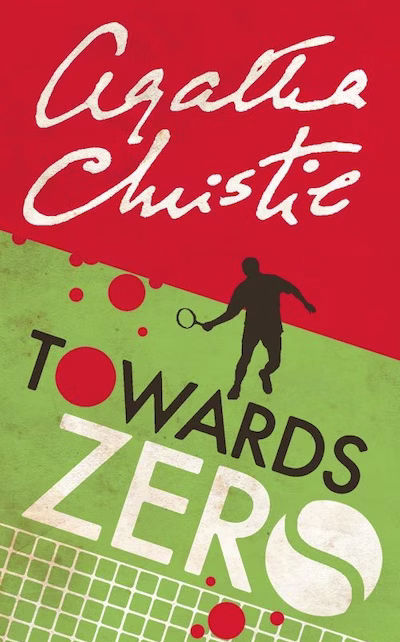
4 | Towards Zero
First published 1944
When tennis pro Nevile Strange convinces his current wife to vacation at the seaside home of a family friend at the same time as the ex-wife he jilted, all their friends – who are also fellow guests – fear this is a recipe for disaster. When the wealthy hostess, Lady Tressilian, is murdered, several guests stand to benefit financially from her will. The detective on the scene isn’t convinced, however, that the motive is monetary. Technically part of the Superintendent Battle series, this novel reads as a standalone book, as the detective never gained the same fame as Hercule Poirot or Miss Marple, and prior knowledge of the character is unnecessary to appreciate the story.
The set-up of this novel is intriguing because unlike most mysteries, the murder doesn’t occur until about halfway through the story. What’s more, the murder is a cover for the true crime which is revealed at the very end of the novel. The series of events and character interactions build up to the “zero hour” of the murder rather than trying to solve the crime after the fact. This book is so well-written, it bamboozled me twice. I first read it several years ago and recently re-read it to refresh my memory. Some of the details started coming back to me as I read. I became convinced I was correctly deciphering the real clues from the red herrings, and I knew who the culprit was, only to be surprised by the twist at the end. This one ranks among my top favorite Agatha Christie novels.
My Goodreads Rating: 5 Stars

5 | Crooked House
First published 1949
Though this novel may have gained some notice in recent years due to the 2017 film adaptation, I believe it’s still one that flies under the radar compared to the popularity of some of Christie’s other books. I think the film — starring Glenn Close, Gillian Andrews, Max Irons, and Stephanie Martini — is well done (probably because the screenplay is written by Downton Abbey creator Julian Fellowes) and worth watching.
When former flame Sophia Leonides’s renowned grandfather is murdered, Charles Hayward, the son of a police detective, is compelled to investigate. Given the circumstances of death, the murderer must be someone within the household of the sprawling Leonides estate. The vast wealth of Aristide Leonides is plenty of motive for several disgruntled or greedy family members squabbling over who should inherit the prominent man’s fortune. Everyone wants the culprit to be the late Aristide’s young wife whom no one likes, but Charles soon realizes that the real solution may not be so neat and tidy.
Crooked House is one of the few Agatha Christie mysteries that I was able to crack, not because it isn’t well-written, but because the clues are more decipherable than those in most of her other novels. Usually, I take a guess at who the culprit is because it’s nearly impossible to solve based on the information (or lack thereof) provided. Much like Dwight Schrute in The Office episode “Murder,” I often chose the character I “most medium suspect.” However, Agatha Christie rarely uses the same plot device twice. Sometimes the murderer is the person you most suspect, or least suspect, or the narrator, or everyone! In the case of Crooked House, Christie satisfactorily casts doubt on several different characters but includes just enough information for the reader to reach the correct conclusion. I appreciate the solvability of this mystery without it being too obvious.
My Goodreads Rating: 5 Stars



Comments